Here is an article from someone who knows much more than I do about the bikes used (and everything else 'cross related, from the early years until now): http://bicyclespecialties.blogspot.com/2008/11/cyclo-cross.html
Friday, September 16, 2011
Cyclocross (Pt II, the bike)
The modern cylocross bike concept as it is known today, evolved from the country and "rough-stuff" bikes of earlier years. The very best classic bikes that were used for 'cross type riding and steeple-chase events were the touring bikes with large tire clearances and wide brake set-ups, or cantilever style brakes. The relaxed geometry of the touring bikes' frame made riding off road easier, and the wider clearances made it easier to clear debris, dirt, and mud.
Here is an article from someone who knows much more than I do about the bikes used (and everything else 'cross related, from the early years until now): http://bicyclespecialties.blogspot.com/2008/11/cyclo-cross.html
Here is an article from someone who knows much more than I do about the bikes used (and everything else 'cross related, from the early years until now): http://bicyclespecialties.blogspot.com/2008/11/cyclo-cross.html

Sunday, August 7, 2011
Cyclocross (Pt I)
A sunny but cold winter day afternoon as the parishioners left of their Sunday mass a strange event gained notice. John and his family, well dressed in their ‘Sunday best,' sauntered toward their home. Suddenly they happened upon an unexpected spectacle of winter. They saw the strange sight of cyclists leaving of the road and beginning to ride through the field and run over the obstacles.
“What a muddy sport!” retorted his wife? A curious man, John approached the group and asked, “What class of cycling is this?” Quickly a joyous reply, “It is called cyclo-cross!”
Cyclocross season is almost here. Like much of bike racing, the sport of Cyclocross is rich in history. You might be asking, "So, what is cyclocross?"
History-

During the late 19th century, it is believed that cyclocross style of riding a bicycle originated during the Autumn in the French countryside when French road racers would race through farmer's fields, taking short cuts, and jumping over fences from one town to another. Early on, this was called "steeple chasing" as the riders would simply ride toward the next town with the landmark they were following being a church steeple.
French generals on horseback observed this strange discipline and moved quickly to train the French Army troops on bikes.

A French soldier named Daniel Gousseau, frequently rode his bicycle over the rough trails and difficult obstacles to maintain cycling fitness during the winter months. Gousseau is credited with organizing the first French National Championship Cyclocross race in 1902.
Numerous other National Championship Cyclocross races started popping up in other European countries shortly there after in places like Belgium, Luxembourg, Spain, and Italy.
It wasn't until 1950 that the UCI caught on and finally sanctioned the first Cyclocross World Championship race, which happened in Paris--48 years after the first National Championship event!
Here in the US, Cyclocross started to become popular on the east and west coast in the 70's with the first National Championship event taking place in Berkely, CA in 1975.
Today, we find the Cyclocross world stronger than ever! With a full European and North American race schedule, and UCI races on both sides of the Atlantic, there are plenty of races to fill up the schedules of riders in the pro ranks. Here in the Midwest, racers will find several Cross races per week. Believe it or not, it is now common to find more competitors and 10 times the spectators at your average Cross race as compared to your average road race here in the Midwest.
Development-

Slowly cyclocross was developing great popularity and promoters searched for short circuits to facilitate spectator's overall vision. Driven by this popularity they looked to central areas of cities, where the courses were characterized by long sections of stairs, paved streets, gardens and small fences (or barriers) similar to the ones utilized today.
As the development progressed, the “Criterium International de Cyclo-Cross” gave way to the World Professional Cyclo-Cross Championships in 1950. The first official World CC Champion was Jean Robic (Fra). Robic, who in 1947 won the Tour de France. He is still the only TdF champion to win the World CC Championship. After Robic the championships were dominated by long “reigns of champions.” Roger Rondeaux (Fra)- 1951, 52, & 53, Andre Dufraisse (Fra)- 1954, 55, 56, 57, & 58, Renato Longo (Ita) 1959, 62, 64, 65, & 67, Eric de Vlaeminck (Bel)-7 WC victories in 8 years (he was the Eddy Merckx of cyclocross), Albert Zweifel (Sui)- 1976, 77, 78, & 79, Roland Liboton (Bel)- 1980, 80, 82, 83, & 84.
In the 80+ years the CX discipline underwent great changes and the sport developed. The “routiers” (strong TT type riders in the peloton) began to realize that good winter ("dead seasons") training in cyclocross provided great preparation for the road season. In an effort to attract more and more road riders the UCI (cycling's governing body) began to standardize the racecourses, making them easier and faster. The “Trou du diable” descents were eliminated (or at least made easier).
Modern CX-
 As the sport grew, some riders abandoned the road-racing schedule and became cyclocross specialists. These cyclocross specialists began to emerge in the mid-1970s and the racecourses slowly returned some of the difficulty of previous years. Today, there are professional cyclocross riders that are paid year round to dedicate themselves to the winter cycling sport.
In the modern era the UCI established regulations to standardize the difficulty of the racecourses. Each circuit should have paved roads, forest and field sections, and obstacles to break the rhythm of the rider. The typical racecourses should be a circuit of a minimum of 2.5 km and a maximum of 3.5 km in length. A properly designed course is 80% to 90% ridable with as many as 4 natural and/or artificial obsticles.
The cyclocross schedule begins early in September in Belgium and finishes late in February. Because of the road season the CC schedule will vary according to the countries. In France the traditional start is in October, while in Spain it is November.
Stay tuned!! Parts 2 & 3 will be all about 'cross bikes and why you should own one, and the local 'cross scene including races (seriously fun to watch) and training sessions.
Saturday, June 11, 2011
Reminder For Sunday June 12th, 2011
Open Streets Minneapolis, 10am-2pm! It should be a great time.
I will be riding to the event by bike, and leaving around 830 or 9ish. If you want to go, contact me and we can ride there together.
I will be riding to the event by bike, and leaving around 830 or 9ish. If you want to go, contact me and we can ride there together.
Sunday, June 5, 2011
A Very Sad, Sad Day

Sadly, today I learned that a Kilmer Pond Neighborhood resident, Sean McQuillen, passed away last night. Farewell on your journey, Sean.
If you wish to read more about his fight with colon cancer, visit the Caring Bridge website: http://www.caringbridge.org/visit/seanmcquillen
I should probably stop typing right now but I'm going to add one last bit. I never personally knew you, Sean, or your wife and family, but I knew of you because since I moved into the neighborhood, I would regularly see you walking your full-sized poodle. What a great, energetic dog. Just like my dog Cleo. In fact, more than a few times we would pass by each other while walking our dogs, always waving and saying "hi" to one another. Occasionally I would see you dog-walking well after dark, and in all weather conditions (like I do with Cleo because of my working hours), always wearing a LED headlamp, the type that only outdoor enthusiasts and fitness nuts must have to keep your hands free... probably just like the one that I have. After I read through your Caring Bridge journal, emotional and all too brief, I learned that you were into mountain biking, rock climbing, endurance sports, and even good beer... all things that I enjoy myself. We even share the commonality of our first name, "Sean".
Even though we did not know each other, I wish we had. The next time I climb a tough route, or bike some nice singletrack in the woods, or feel like just giving up on my next distance run, I'll think of your steadfast determination that was so eloquently described by your wife in the Caring Bridge journal. I am without words.

Northern Spark Festival Ride
Last night after I came home from work, I rode downtown to see the Northern Spark Festival, "an [artistic] experiment in light and sound." It was a peaceful, relaxing ride after dark. With the right set of bike lights, it is actually fun to ride at night under the stars, in the coolness of the evening.
I took the Cedar Lake Trail into downtown Minneapolis. I haven't ridden the trail since last fall and, to my surprise, at the normal end of the trail (basically Royalston & Glenwood Ave) was a continuation, going under Target Field and linking up with West River Parkway trail. I followed this to the Stone Arch Bridge. I have detailed my exact route here.
Here are some pictures (sorry for the poor quality... low light with an iphone):


I took the Cedar Lake Trail into downtown Minneapolis. I haven't ridden the trail since last fall and, to my surprise, at the normal end of the trail (basically Royalston & Glenwood Ave) was a continuation, going under Target Field and linking up with West River Parkway trail. I followed this to the Stone Arch Bridge. I have detailed my exact route here.
Here are some pictures (sorry for the poor quality... low light with an iphone):


My stops included the Stone Arch Bridge, Riverplace/St. Anthony Main, Loring Park, Minneapolis College of Art and Design, and Intermedia Arts. The Tibetan art exhibit was one of my favorites. I left the Uptown area and about an hour or so later, got home exhausted (mostly from the late hour) around 3:30am! Oh well, life is short.
Wednesday, June 1, 2011
"Any Bike, Anywhere"
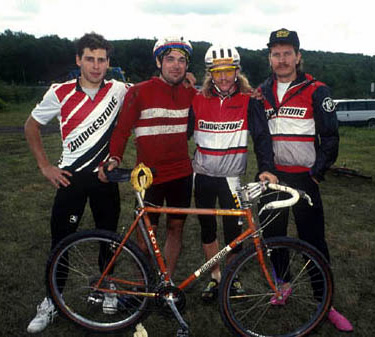 |
| L-R: Harry Winand, Gene Oberpriller (One On One Bike Studio, owner), John Stamstad, Chris Kostman at the 24 Hours of Canaan |
Ahhh, the late '80s and all through the '90s... some of my fondest memories of riding my bike come from this time. I had my brand new Raleigh mountain bike given to me as a birthday gift from mom, a bike that I had picked out in the Now Sports bike shop in Uptown. The shop was a dealer of many different brands of bikes, but the one brand I remember the most, the one I kept coming back to were the Cannondales. American made, large diameter aluminum tube race bikes with top-of-the-line componentry, bright, metallic paint and skinny, slick tires... "to go fast!"
For all of my lusting after the mucho dinero C'dales, and begging mom to reconsider, the final decision to get me a 21 speed, steel Raleigh mountain bike was a very wise one. The basic mountain bikes of those times actually were to become--and very commonly used as--fairly decent, durable, all around urban bikes. 90% of my riding consisted of getting around the city, for transport and for recreation. I was even able to keep up with, and in some cases, ride faster than, spandex-clad road bikers on those high dollar race bikes I had been lusting after. The point is, I made due with what I had.
This brings me to one of the best bike articles I have come across on the internets, authored by a man named Chris Kostman:
"Any Bike, Anywhere"
If you have the time (and I know you do for such a well written and convincing article!) please read it. The moral to all of this is to get out and ride, no matter what bike you have.
1st post on the blog
Hey everyone, let's get out and go biking.
I moved to the Kilmer Pond Neighborhood in the fall of 2009, and after not getting much bicycle riding in during the nicer months of 2010 I decided to change that for this year.
Last summer I decided to help my parents get out with me and exercise together as a family. What better way to spend a nice summer day than on a bike?! I can't think of one... anyhow, I found mom a "garage queen" Schwinn cruiser on CL, and dad had recently acquired a second hand road bike from his best friend. Mom's bike needed little more than new tires; I took dad's bike to a local bike shop and had it overhauled.
Last summer I decided to help my parents get out with me and exercise together as a family. What better way to spend a nice summer day than on a bike?! I can't think of one... anyhow, I found mom a "garage queen" Schwinn cruiser on CL, and dad had recently acquired a second hand road bike from his best friend. Mom's bike needed little more than new tires; I took dad's bike to a local bike shop and had it overhauled.
With their new/second-hand bikes up and running I promptly got them out of the house, onto their bikes, and down to the North Cedar Lake Regional Trail. I led the ride, and that day we rode at a leisurely pace all the way to downtown Minneapolis, stopping for lunch at One On One Bike Studio. I think my parents were a little surprised by how relatively quickly and easily a cyclist could get from St. Louis Park to downtown Minneapolis.
Indeed... there are good reasons why Minneapolis was rated the #1 bike-friendly city in the country.
I started this blog because I believe that our neighborhood is a great gateway area to many fantastic trails, both to the East and extending far to the West. I intend this to be a place to:
A) Organize and post about neighborhood group rides for all ages. Some rides can be tailored specifically for kids (short distances), and others can be rides for more experienced cyclists (longer distances).
B) Share bicycling related information.
C) Get more people, young and old, involved in bicycling.
 |
| Last week I rode to Excelsior on the Lake Minnetonka LRT Regional Trail. |
Subscribe to:
Posts (Atom)